Hermeneutyka pedagogiczno-religijna w dobie algorytmów
Abstrakt:
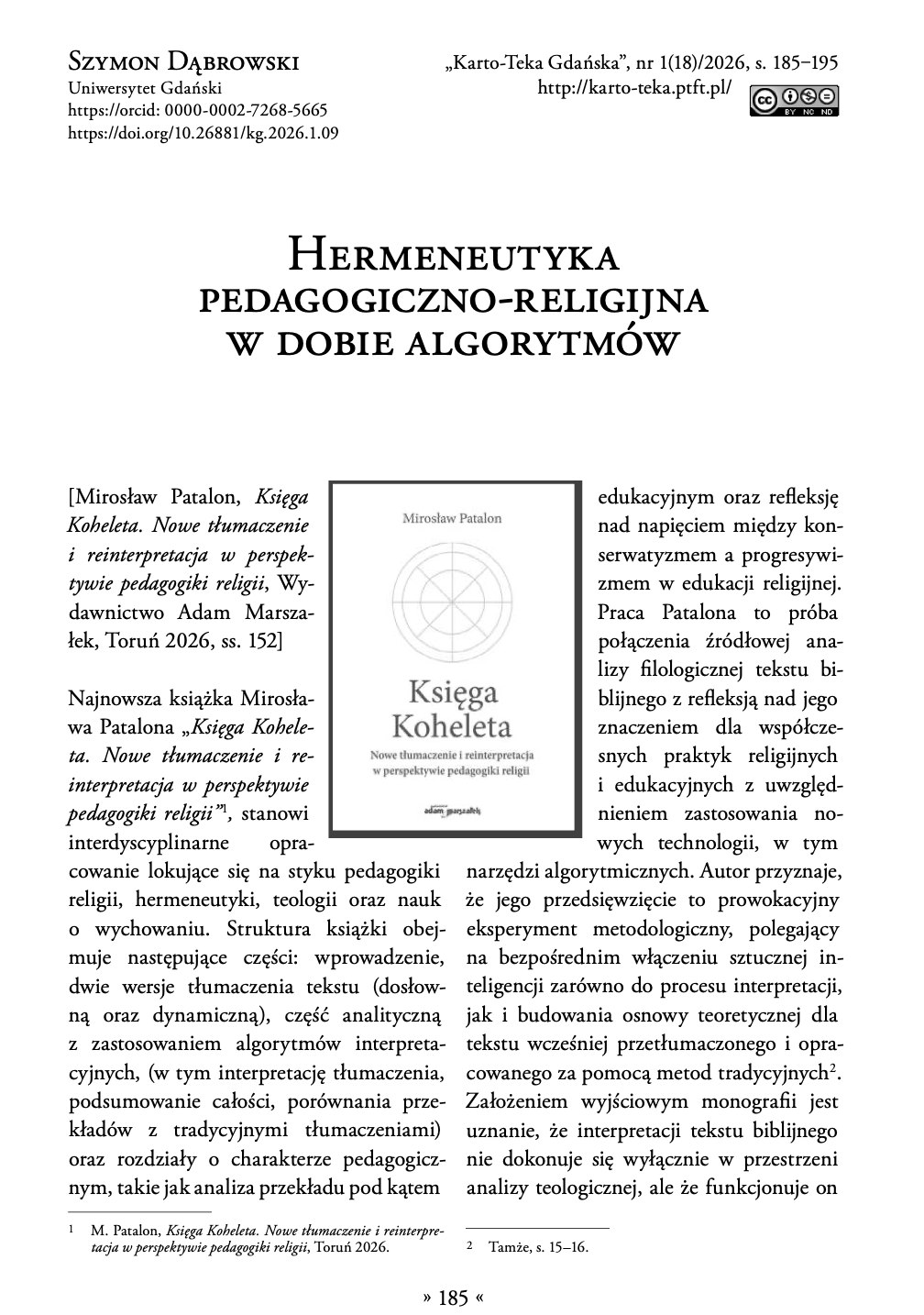
Artykuł stanowi krytyczno-analityczną recenzję książki Mirosława Patalona „Księga Koheleta. Nowe tłumaczenie i reinterpretacja w perspektywie pedagogiki religii”. Celem opracowania jest ukazanie znaczenia interdyscyplinarnego podejścia łączącego hermeneutykę, pedagogikę religii oraz wykorzystanie narzędzi algorytmicznych w interpretacji tekstu biblijnego. Autor wskazuje na kluczową rolę języka i przekładu jako czynników kształtujących doświadczenie religijne i praktyki edukacyjne. Szczególną uwagę poświęcono dwóm wariantom tłumaczenia (dosłownemu i dynamicznemu), które ujawniają napięcie między wiernością oryginałowi a jego współczesną aktualizacją. Analiza podkreśla również znaczenie reinterpretacji pojęć (np. „hevel” - „marność” na „ulotność” – „mgła”) oraz wpływ decyzji translatorskich na formację aksjologiczną. Istotnym wątkiem jest wykorzystanie algorytmów jako współuczestników procesu interpretacyjnego, co rodzi pytania o granice autorstwa i status poznawczy wyników. W wymiarze pedagogicznym tekst wskazuje na potrzebę syntezy między konserwatyzmem a progresywizmem w edukacji religijnej. Całość wpisuje się w nurt pedagogiki procesualnej i dialogicznej, postulując traktowanie edukacji jako procesu interpretacyjnego w porządku społecznym, kulturowego oraz tożsamościowym.
Słowa kluczowe: pedagogika religii, edukacja religijna, Księga Koheleta, procesualność, hermeneutyka, algorytmy, interpretacja, teoria wychowania
Pedagogical-Religious Hermeneutics in the Age of Algorithms.
Abstract:
The article constitutes a critical-analytical review of the book by Mirosław Patalon, „The Book of Qohelet: A New Translation and Reinterpretation from the Perspective of Religious Education”. The aim of the study is to demonstrate the significance of an interdisciplinary approach that combines hermeneutics, of religious education, and the use of algorithmic tools in the interpretation of biblical texts. The author points to the key role of language and translation as factors shaping religious experience and educational practices. Particular attention is devoted to two variants of translation (literal and dynamic), which reveal the tension between fidelity to the original and its contemporary actualization. The analysis also emphasizes the importance of reinterpreting key concepts (e.g., “hevel” – from “vanity” to “transience” or “mist”) and the impact of translation decisions on axiological formation. An important thread is the use of algorithms as co-participants in the interpretative process, which raises questions about the limits of authorship and the epistemic status of the results. In the pedagogical dimension, the text highlights the need for a synthesis between conservatism and progressivism in religious education. As a whole, the article aligns with the current of processual and dialogical pedagogy, postulating the treatment of education as an interpretative process within social, cultural, and identity frameworks.
Keywords: the pedagogy of religion, religious education, Ecclesiastes, processuality, hermeneutics, algorithms, interpretation, educational theory
http://karto-teka.ptft.pl/images/biezace_numery/2026_1/artykuly/kartoteka_gdanska_2026_nr18_12.pdf